Dementia Prevention Naturally by Felix Veloso
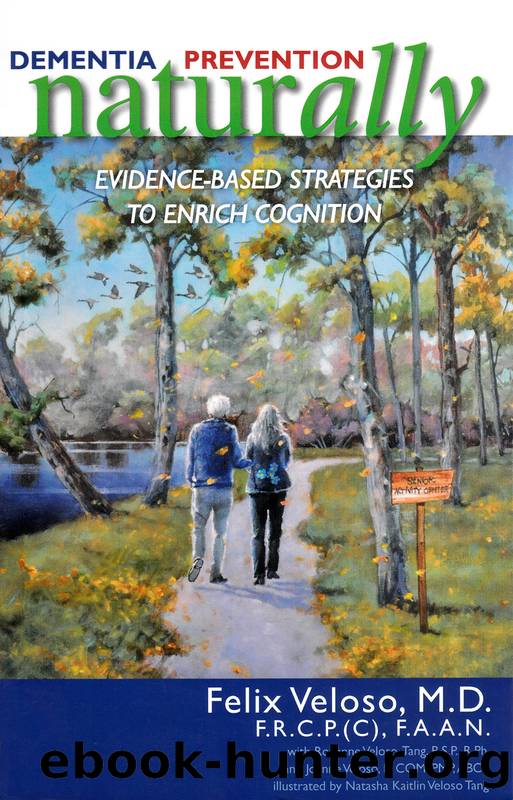
Author:Felix Veloso
Language: eng
Format: epub
ISBN: 9781459341142
Publisher: Your Nickel's Worth Publishing
Published: 2014-11-15T00:00:00+00:00
⢠Drink coffee or tea with a whole grain breakfast.
⢠Drink tea or eat fruit with a plant-based lunch.
⢠Drink wine or tea with a leisurely Mediterranean diet dinner.
⢠Eat fruits and vegetables as snacks.
Mindful Micronutrients
âWhen diet is wrong, medicine is of no use When diet is correct, medicine is of no need.â
~ ANCIENT AYURVEDIC PROVERB
âDiet cures more than the doctor.â
~ MAXIM
Nutritionists differentiate food into broad categories of macronutrients and micronutrients. Macronutrients, further subdivided into carbohydrates, proteins, fats and water, are required in large (macro) amounts to supply the organism with energy and tissue-building substances.
Micronutrients are essential nutrientsâpredominantly vitamins and trace metalsâthat are needed in very small (micro) quantities by the body to maintain optimal physiological functions, and by the brain to provide antioxidants to neutralize toxic free radicals produced during normal physiological oxidative activities and from exposure to sunlight, irradiation and environmental pollutants, such as cigarette smoke.
Micronutrientsâincluding microminerals or trace elements such as zinc, magnesium, and selenium, and vitamins like C and E, which are organic compounds not or insufficiently synthesized by the body and therefore must be obtained from dietâpossess diverse physiological functions, but most are antioxidants.
A third class of micronutrients is the bioactive compounds found in almost every known plant: phytochemicals. Phytochemicals, particularly polyphenols, are present in most fruits, vegetables, grains, legumes, nuts, and certain edible oils. All are potent antioxidants.
âWhat are antioxidants?â Sophie puzzled.
âAntioxidants, or anti-oxidation agents, are molecules that inhibit the oxidationâthe loss of electronsâof other molecules by binding with free radicals,â I explained.
âWhat are free radicals?â Sophie asked.
âFree radicals are atoms that have at least one unpaired electron, which makes them highly reactive. Free radicals, when derived from oxygen, are called oxygen-free radicals or reactive oxygen species (ROS), and are the products of normal cellular metabolism. They have both negative and positive health properties. In low or moderate concentrations, ROS combats invading infectious agents, but when there are too many free radicals, the antioxidants in the body are overwhelmed, causing oxidative stress that leads to aging, neurodegeneration and malignancies,â I replied.
âWhat is oxidation and why is it harmful?â Sophie wondered.
I took my time with my answer, summarizing the following information.
Oxidation is the chemical interaction between oxygen molecules and other substances. Technically, oxidation is defined as the loss of at least one electron when two or more substances interact. Those substances may or may not include oxygen. The opposite of oxidation is reductionâthe addition of at least one electron when substances come into contact with each other. In a chemical reaction, the molecule that loses the electron is oxidized and the element that gains the electron is reduced. Oxidation is almost always destructive to both inorganic entities and animate organisms. Corrosion, which is the oxidation of iron, changes the strong metal into weak rust. Oxidation turns fresh colourful produce, like apples and bananas, into unappetizing brownish discolored spoilage after slicing. This harmful oxidative reaction can be inhibited by natural antioxidants like lemon and pineapple juices.
In live organisms, the normal activities of daily living produce free
Download
This site does not store any files on its server. We only index and link to content provided by other sites. Please contact the content providers to delete copyright contents if any and email us, we'll remove relevant links or contents immediately.
| Administration & Medicine Economics | Allied Health Professions |
| Basic Sciences | Dentistry |
| History | Medical Informatics |
| Medicine | Nursing |
| Pharmacology | Psychology |
| Research | Veterinary Medicine |
Periodization Training for Sports by Tudor Bompa(8334)
Why We Sleep: Unlocking the Power of Sleep and Dreams by Matthew Walker(6786)
Paper Towns by Green John(5248)
The Immortal Life of Henrietta Lacks by Rebecca Skloot(4641)
The Sports Rules Book by Human Kinetics(4451)
Dynamic Alignment Through Imagery by Eric Franklin(4271)
ACSM's Complete Guide to Fitness & Health by ACSM(4091)
Kaplan MCAT Organic Chemistry Review: Created for MCAT 2015 (Kaplan Test Prep) by Kaplan(4054)
Livewired by David Eagleman(3828)
Introduction to Kinesiology by Shirl J. Hoffman(3810)
The Death of the Heart by Elizabeth Bowen(3679)
The River of Consciousness by Oliver Sacks(3638)
Alchemy and Alchemists by C. J. S. Thompson(3555)
Bad Pharma by Ben Goldacre(3467)
Descartes' Error by Antonio Damasio(3321)
The Emperor of All Maladies: A Biography of Cancer by Siddhartha Mukherjee(3210)
The Gene: An Intimate History by Siddhartha Mukherjee(3139)
The Fate of Rome: Climate, Disease, and the End of an Empire (The Princeton History of the Ancient World) by Kyle Harper(3091)
Kaplan MCAT Behavioral Sciences Review: Created for MCAT 2015 (Kaplan Test Prep) by Kaplan(3025)
